


Sun, Wind and Sovereignty

Can Vietnam’s Energy Boom Loosen China’s Grip?
eyesonvietnam
Ask who powers Vietnam’s future and you will hear a confident story: solar fields across the south-central coast, wind turbines on the horizon, giant batteries to hold it all together. Ask whether this makes Vietnam independent from China and the honest answer is more complicated. Vietnam is cutting some dependencies on China while quietly deepening others.
The plan: tripling the green share
Vietnam’s revised national power plan, PDP8, targets up to 73 GW of solar and about 50 GW of wind (onshore and offshore) by 2030, more than triple the levels currently installed. The urgency is real. Coal supplied more than half of Vietnam’s electricity in 2020, and the country was the world’s tenth-largest coal power generator. Vietnam has also been a net energy importer for years, and imported fuel is exposed to price shocks and geopolitics.
Project one: solar, the success story

Vietnam’s solar surge came first and fastest. Capacity reached roughly 16,600 MW against an estimated potential of 963,000 MW. It also built a manufacturing industry, with module exports reported at more than $5 billion.
Project two: wind, with offshore as the long game

The most ambitious chapter is at sea. Vietnam has about 43 offshore wind projects at various stages of development, with new survey licences still being issued in 2026. The revised plan expects offshore wind of 6,000 to 17,032 MW between 2030 and 2035, later than first hoped, while onshore and nearshore wind take priority for now. Some projects look outward: wind-to-Singapore/Malaysia export projects totalling 3,000 MW are expected from 2033.
Project three: storage, the missing piece
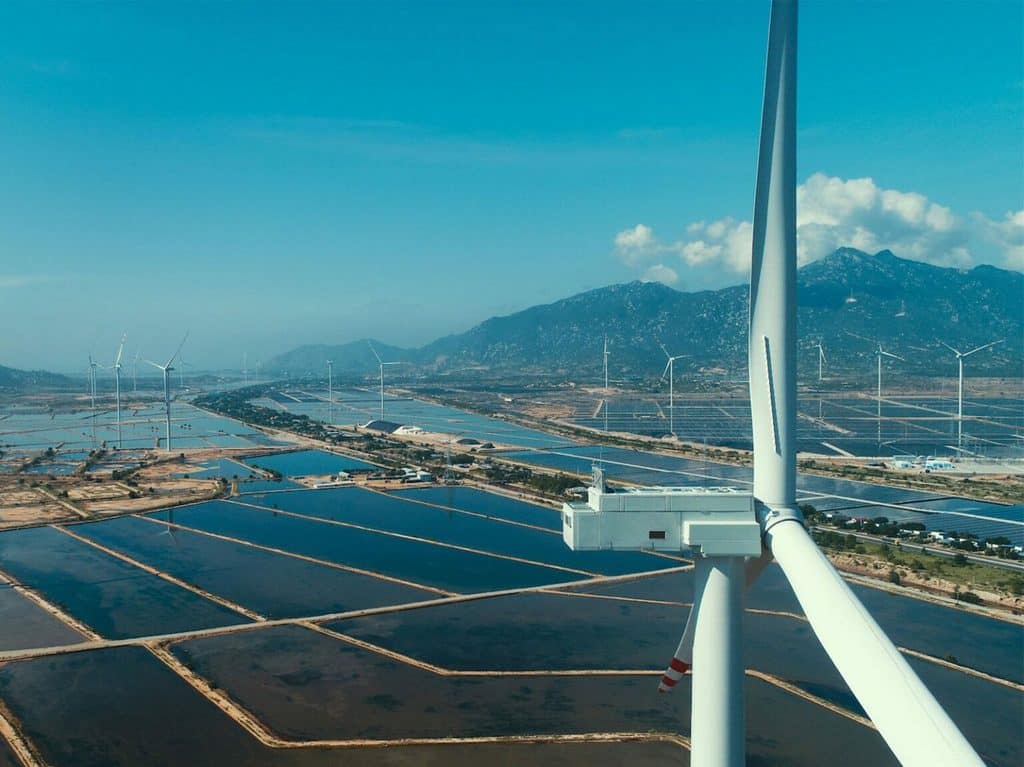
Solar and wind are useless at night or in calm weather without storage, and this is where Vietnam is building fastest.
- Pumped storage: Bac Ai in Ninh Thuan will be the country’s first pumped storage hydropower facility, with 1,200 MW of capacity. Its first unit is expected in December 2029.
- Batteries: Vietnam’s battery target jumped from just 300 MW to at least 10 GW. A new tariff structure in January 2026 made Vietnam the first major ASEAN economy with a formal two-part tariff for standalone storage.
- Factories: In April 2026, GG Power opened a 5 GWh battery storage factory in Hung Yen, and Vingroup’s VinES is co-building a $275 million plant making 30 million LFP cells a year with Gotion.
- Nuclear: Vietnam signed an intergovernmental agreement with Russia in March 2026 for two VVER-1200 units totalling 2,400 MW at Ninh Thuan 1. Nuclear is not renewable, but it belongs in the same strategy of reducing fossil fuel imports.
Where independence from China is real
Electricity imports. Vietnam has long worried about relying on neighbors’ power. Most of its electricity imports have historically come from China, and officials have discussed buying from Laos to minimize the risks from relying on Chinese imports. Domestic solar, wind and storage reduce the need to import at all.
Fuel. Every kilowatt-hour from the sun or wind is one that needs no imported coal or LNG. This matters because the plan still leans on imports: the revised PDP8 keeps LNG capacity near 22,500 MW, indicating continuing reliance on imported LNG.
Diversified partners. The nuclear deal with Russia and wind cooperation with the UK show Vietnam deliberately spreading its bets across partners.
Water. There is a Mekong angle too. China has built 11 dams at the top of the Mekong with severe impacts on downstream flows. Less reliance on hydropower and more wind and solar means less exposure to upstream water politics.
The uncomfortable truth: the equipment is Chinese
Vietnam’s solar boom is built on Chinese supply chains. A World Bank-linked study found that Chinese-owned firms account for 75% of Vietnam’s solar exports and 50% of jobs, with China supplying most of the inputs. Researchers described it as deep integration into China’s subsidized supply chains. Even domestic firms rely on Chinese parts, which are around 50% cheaper when sourced from China.
The pattern repeats in storage. GG Power’s factory is based on technology transfer from Chinese company Goldwind, and the VinES cell plant is a partnership with Gotion, another Chinese firm. Vietnam is building local factories, but with Chinese know-how.
So how independent?
The fairest answer is that Vietnam is trading one kind of dependence for another, and the new kind is much safer.
| Before | With renewables | |
|---|---|---|
| Fuel | Imported coal, LNG | Domestic sun and wind |
| Electricity | Imports, partly from China | Mostly self-generated |
| Equipment | Imported | Increasingly made in Vietnam, with Chinese inputs and technology |
An imported solar panel is a one-time purchase. It does not need refuelling, cannot be cut off by a pipeline dispute and keeps working whatever happens in diplomacy. That is a real gain in energy security even if the panel came from a Chinese-owned factory.
But if Vietnam wants genuine independence, the next step is not generating power but making the equipment, and the clearest warning is the grid: transmission congestion has already constrained project output in southern and central provinces, and batteries and pumped storage are only now arriving. The projects are advanced. The sovereignty is still being built.