


Trust Before Habit

How Vietnam Is Learning to Live With AI
eyesonvietnam
Walk into a Hanoi café or a Saigon co-working space and you’ll see it quickly: students translating with a chatbot, shop owners drafting product descriptions, designers generating mood boards. Vietnam is not approaching artificial intelligence with fear. It is approaching it with something closer to appetite, and the interesting question is what happens when that appetite meets classrooms, factories, and rice paddies.

A Nation That Says Yes to AI
Surveys suggest Vietnamese urban consumers are among the world’s most welcoming toward the technology. In the 2025 WIN World AI Index, Vietnam ranked 6th out of 40 countries, 3rd globally in AI trust and 5th in AI acceptance. A separate consumer study found that 78 percent of respondents had used AI tools, with 33 percent already using them in their daily routines, and more than half of AI users pay for subscriptions. Global products dominate, with ChatGPT used by most people, though one local platform, AI Hay, came close to ChatGPT in satisfaction.
The picture is more nuanced than the headlines. These are online and big-city samples, and the two studies measure different things: the WIN survey found that around 60 percent of city residents had tried AI but only 3 percent used it daily. Enthusiasm runs ahead of habit. There is also a clear generational and geographic divide. Nearly 90 percent of 18-to-24-year-olds in Hanoi and Ho Chi Minh City had used AI, while in Da Nang only about one in ten people aged 55 to 64 had.

Worries exist but are modest. Data privacy is the top concern, at 52 percent, while only 36 percent worry about misinformation and deepfakes, the lowest of the AI concerns surveyed. Researchers read this as a population that is optimistic about technology as a route to progress, in a country where rapid change within one lifetime is part of living memory.
Is AI Part of Education? Increasingly, Yes
The most telling sign of that optimism is policy. After a pilot during the 2025-2026 school year, the Ministry of Education and Training issued a national framework in August 2026, and students will receive 12 periods of AI education each academic year, running from grade 1 to grade 12 starting in the 2026-2027 school year.

The framework is less about tools than about judgment. It is built around four areas: human-centered thinking, AI ethics, AI techniques and applications, and AI system design. Primary pupils learn to recognize AI in daily life, with early lessons on data protection and copyright. Older students use AI tools to make digital products and solve study problems, and high schoolers design and improve simple AI tools through science projects. The stated aim is for young people to become informed users rather than passive consumers. National targets go further: at least 80 percent of general education students with basic AI skills by 2030.
Reality will be uneven. Schools can fold AI into existing subjects, clubs, or dedicated modules, and early reports described uneven readiness during the pilot. A rural primary school in Dien Bien introduced AI content to 572 students after training its teachers, but not every school has that support. Even the prime minister has urged schools toward the selective use of AI alongside stronger digital and STEM skills. The hardest questions, such as homework honesty, teacher training, and the gap between city and countryside, will be answered in classrooms, not ministries.
Robots on the Factory Floor
Vietnam’s role as a manufacturing hub makes automation an economic necessity as labor costs rise. The showcase is VinFast’s Hai Phong complex, where ABB robotic arms work alongside synchronized machines and remotely supervising humans. Homegrown ambitions are growing too: Vingroup’s robotics arm signed an agreement with Skild AI in June to explore embodied AI and robot manipulation, and AMC Robotics is keeping its Vietnam robot production plans on track for the second half of 2026, which would deepen the country’s role in making advanced technology for foreign firms.
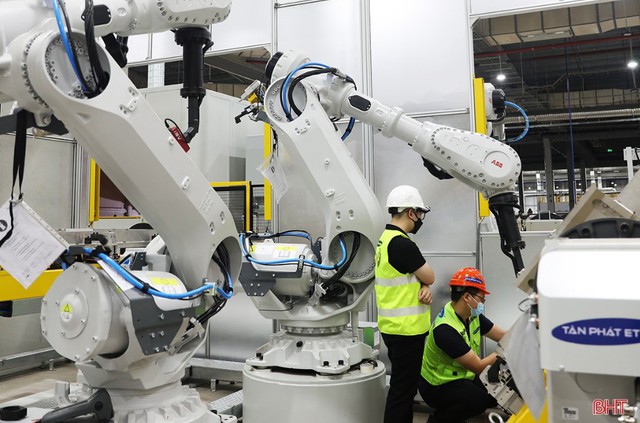
Hype deserves caution. Analysts note that many factories still run isolated automation systems rather than integrated smart-manufacturing platforms, and humanoid robots remain, in one trade outlet’s words, an immature market. The real transformation is likely to be unglamorous: sensors, vision systems, and robotic arms that raise quality and productivity line by line, and a growing need for technicians who can run them.
Drones Over the Delta
In agriculture, the change is already visible from above. The Mekong Delta grows half of the nation’s rice, and its farmers are adopting spraying and seeding drones fast. One manufacturer estimates that as many as 4,000 are operating in Vietnam. Because the drones apply inputs precisely, farmers need less pesticide and fertilizer than by hand, and industry analysts estimate pesticide savings of up to 30 percent.
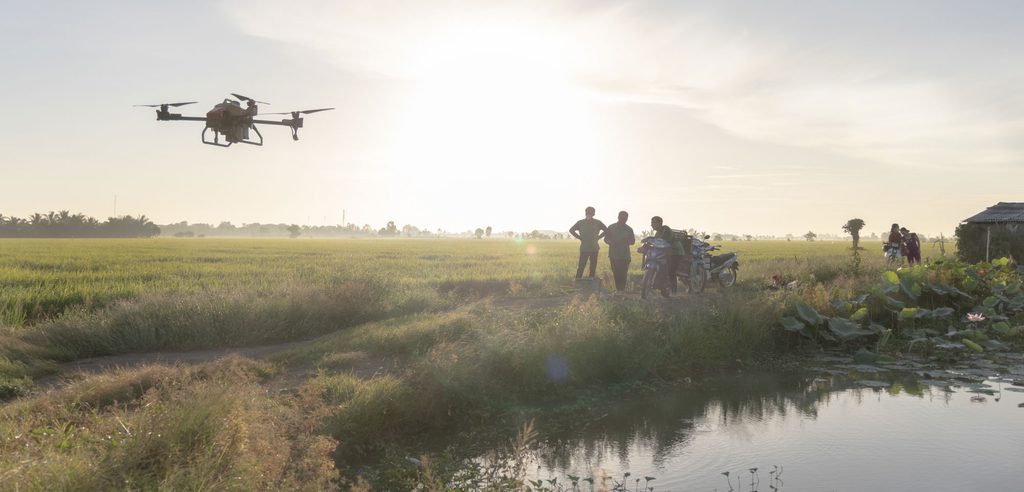
There is a human side to this story. During the pandemic, many young people who had left their villages returned home and discovered the drone-pilot profession, a way to stay in farming without the heavy physical strain. At the same time, drones may undercut a traditional way of life and may be financially out of reach for many. Research projects are trying to widen access: a joint Australian-Vietnamese team produced AI-enhanced crop condition maps from satellite and drone imagery for smallholder farmers in Tay Ninh, An Giang, and Dong Thap, and Can Tho is set to host a training centre for drone pilots and agricultural robotics technicians. A Can Tho University professor cautions that most smart-agriculture applications in the Delta are still at the narrow AI stage, such as sensors, disease recognition on phones, and environmental alerts.
A Final Thought: Adoption Is the Easy Part
Vietnam has the ingredients many countries lack: a young population, high public trust, and a government pushing AI into schools and industry at the same time. But trust is not the same as mastery. The country’s challenge is to turn curiosity into skill, closing the gaps between city and village, young and old, and the farmer who can buy a drone and the one who cannot. If it succeeds, AI in Vietnam will not be remembered as a tool imported from abroad, but as one more thing Vietnamese people took in, adapted, and made their own.